
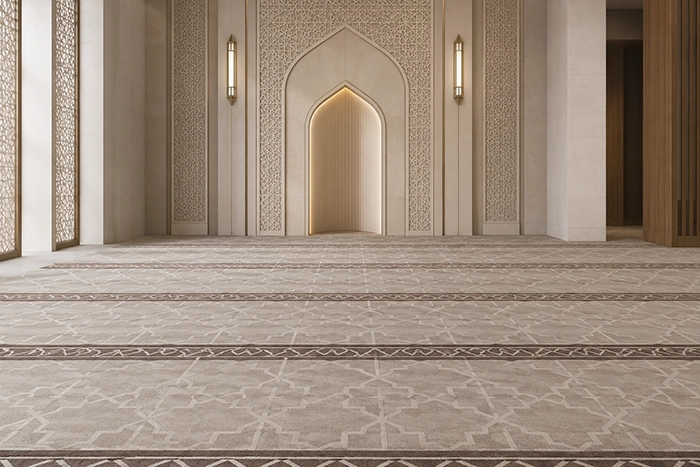
From Tradition to Contemporary Aesthetics
For decades, mosque carpets followed highly traditional designs rooted in Persian, Ottoman, or geometric Islamic patterns. While these remain relevant, modern mosque architecture has inspired a wave of updated carpet styles that blend spirituality with minimalism. Today’s mosque carpets must align with contemporary interiors while still preserving religious function and harmony.
As stated by Dr. Khalid Al-Rashid, Islamic architecture scholar:
“Designing prayer spaces today requires a balance between tradition and contemporary spatial identity.”
1. Minimal Geometric Patterns
Modern mosque carpets often incorporate clean geometric shapes, symmetrical borders, and minimalistic motifs. These designs:
• Reduce visual clutter
• Match modern architecture with glass, steel, or neutral tones
• Appeal to younger generations and urban communities
Instead of floral or curvilinear motifs, linear mihrab patterns are increasingly common, especially in urban mosque projects in the UAE and Qatar.
2. Monochrome and Neutral Color Palettes
Traditional mosque carpets featured vibrant reds, blues, and golds. However, modern styles tend to use:
- Greys, beige, stone, olive, and soft greens
- One or two-toned backgrounds
- Subtle contrasts for mihrab rows
This aesthetic allows the focus to remain on architecture and lighting, and creates a calm, meditative environment.
3. Custom-Made Row Alignment
Modern prayer carpets are not only about visual appeal but also functionality. With the help of CAD software, factories like Pamchal can produce carpets that:
- Precisely align with architectural plans
- Fit curved or multi-level layouts
- Ensure clear prayer row spacing with visual cues
This is especially valuable in large mosques, airports, or prayer halls with unique shapes.
4. Eco-Conscious Materials and Techniques
As sustainability gains importance, modern designs increasingly favor:
- 100% heat-set acrylic (durable and low-VOC)
- Anti-bacterial and mold-resistant finishes
- Recyclable underlays and thermal-insulated backings
These materials help meet international building codes while offering long-term performance.
5. Cultural Fusion in Design
Some modern mosque carpets blend Islamic motifs with local or international design elements. For example:
- Scandinavian-inspired minimalism with Arabic calligraphy
- Geometric North African motifs integrated into prayer lines
- Soft Turkish patterns with neutral backgrounds
This fusion appeals to international mosques or B2B buyers aiming for distinct yet respectful design.
Conclusion – Modern Design with Spiritual Integrity
Modern mosque carpet design goes beyond aesthetics—it reflects a shift in community needs, architecture, and global style trends. While honoring Islamic tradition, Pamchal and other innovators now offer designs tailored to contemporary worship spaces.
For B2B clients, these styles offer both form and function—ensuring beauty, alignment, and spiritual integrity.