
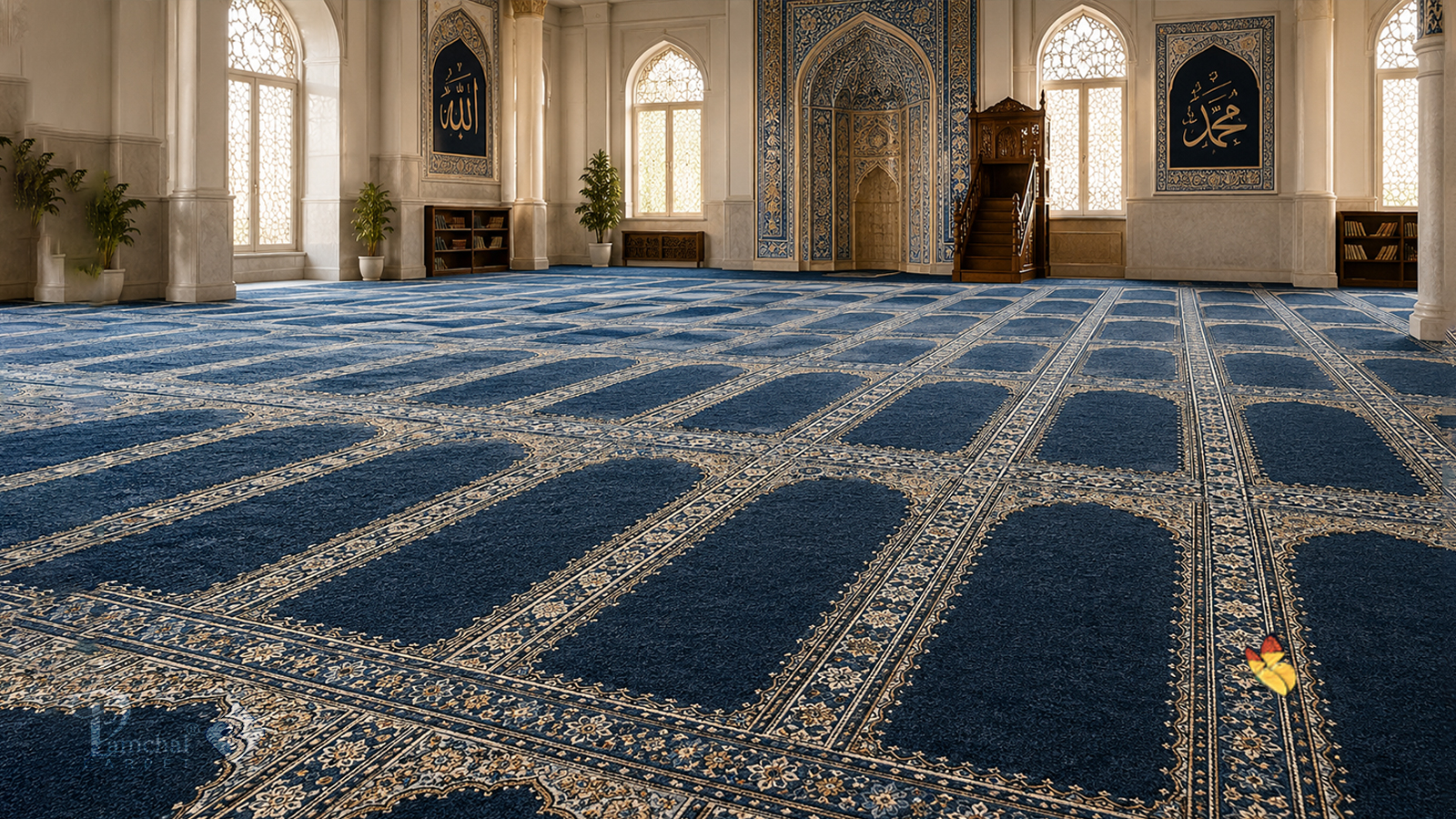
Why Prayer Hall Carpets Require Specialized Design
Prayer hall carpets differ fundamentally from residential, office, or hotel carpets. Their role goes far beyond decoration; they function as an essential architectural and spiritual element within the space. In mosques, religious institutions, and prayer halls, carpets directly influence worshippers’ posture, movement, hygiene, and sense of order. A poorly designed carpet can disrupt alignment, cause discomfort, or even compromise safety and cleanliness.
Prayer carpets must withstand intensive daily use, often accommodating hundreds or thousands of worshippers multiple times a day. They must facilitate organized congregation, support physical comfort during prayer movements, and visually reinforce the sacred nature of the space. For this reason, manufacturers like Pamchal design prayer hall carpets with a specialized approach that balances technical durability, ergonomic comfort, and symbolic design—ensuring the carpet serves both faith and function over many years.
Understanding the Functional Role of Carpets in Prayer Spaces
In prayer halls, the carpet effectively replaces furniture. Worshippers sit, kneel, and prostrate directly on the floor surface, making the carpet a primary interface between the human body and the building. Unlike other environments, where furniture absorbs wear and weight, prayer carpets must handle continuous pressure from knees, feet, and foreheads while maintaining shape, texture, and cleanliness.
Additionally, prayer halls are communal spaces governed by discipline and unity. The carpet plays a silent but powerful role in organizing this collective movement. Through visual cues and spatial guidance, it helps worshippers align, maintain spacing, and perform rituals smoothly—without verbal instruction or physical barriers.
1. Clear Prayer Row Alignment (Saff Design)
The most critical functional feature of any prayer hall carpet is the saff design, which defines the rows for worshippers. These rows are typically marked using mihrab arches, horizontal borders, or subtle geometric lines that point toward the Qibla. Clear saff alignment ensures that worshippers can immediately recognize where to stand, kneel, and prostrate, even in large congregations.
Well-designed saff patterns promote discipline, unity, and visual harmony. They reduce crowding, prevent uneven spacing, and allow the congregation to form straight rows naturally. In busy prayer halls, this clarity significantly improves flow and reduces confusion during peak prayer times.
Key Design Requirements for Effective Saff Layout
An effective saff design must meet several precise criteria:
- Consistent spacing between rows, typically around 80 cm, to accommodate prayer movements
- Clear directional orientation toward the Qibla without ambiguity
- Repetition of motifs that guide alignment without creating visual clutter
Pamchal custom-produces prayer carpets with precisely calculated saff layouts, including wide-format carpets up to 4 meters, ensuring seamless alignment across large prayer spaces without disruptive seams.
2. Comfort for Prolonged Sitting and Prostration
Prayer involves repeated physical movements, including standing, bowing, sitting, and prostration. Over time, inadequate carpet cushioning can lead to knee pain, joint strain, and general discomfort—particularly for elderly worshippers. Therefore, comfort is not a luxury but a functional necessity in prayer hall carpet design.
The ideal prayer carpet provides softness without excessive sinking. Materials such as high-grade heat-set acrylic yarn offer a resilient surface that cushions pressure points while maintaining structural integrity. Medium pile height ensures comfort during prolonged sitting while allowing stable footing during standing.
Recommended Technical Specifications
For optimal comfort and durability, professional prayer carpets typically feature:
- Pile height between 10–12 mm for balanced support
- 100% heat-set acrylic yarn for resilience and softness
- Density ranging from 1,000,000 to 1,200,000 points per square meter
These specifications help preserve posture, reduce fatigue, and maintain a dignified tactile experience throughout daily prayers.
3. Durability for High-Traffic Environments
Prayer halls are among the highest-traffic interior spaces. Daily footfall, repeated movements, and regular cleaning place significant stress on carpets. Without proper structural reinforcement, carpets can quickly lose shape, flatten, or fray—leading to costly replacements.
Machine-made carpets designed for prayer halls incorporate reinforced backing systems and strong edge binding to withstand heavy use. Dimensional stability is essential to prevent shrinking, rippling, or misalignment of saff rows over time.
Pamchal employs advanced backing solutions such as latex backing or double-weft construction, significantly extending carpet lifespan and maintaining visual consistency even in demanding environments like large mosques and institutional prayer halls.
4. Antibacterial and Hygienic Properties
Hygiene is a critical consideration in prayer halls, where worshippers pray barefoot and share the same floor surface. High foot traffic combined with moisture from ablution increases the risk of microbial growth if carpets are not designed with hygiene in mind.
Modern prayer carpets often incorporate antibacterial treatments that inhibit the growth of bacteria and fungi, reducing odors and maintaining a cleaner environment. Moisture-resistant yarns further protect against mold formation—an especially important factor in humid climates such as the GCC region.
Pamchal offers prayer carpets with certified antibacterial performance upon request, providing peace of mind to institutions prioritizing health and cleanliness.
5. Non-Slip Performance and Safe Installation
Safety is another essential aspect of prayer hall carpet design. Large open spaces with smooth underlying surfaces—such as marble or polished tile—require carpets that remain firmly in place. Slipping or shifting carpets pose a serious risk, particularly during crowded prayers.
Prayer carpets must have sufficient weight and backing grip to prevent movement. In many installations, professional underlays or adhesive systems are used to secure carpets permanently. Proper installation ensures that saff alignment remains intact and that worshippers can move confidently without fear of slipping.
6. Aesthetic Harmony with Religious Architecture
Beyond technical performance, prayer carpets must visually support the spiritual atmosphere of the space. Colors, patterns, and motifs should complement the mosque’s architecture rather than distract from it. Traditional Islamic designs—such as arabesques, geometric repetition, and mihrab motifs—help reinforce a sense of sacred order.
Muted, dignified color palettes such as burgundy, green, navy, or earth tones are commonly favored, as they promote focus and calm. Overly bright or busy designs can disrupt concentration and diminish the contemplative nature of prayer.
Pamchal offers a wide range of ready-made prayer carpet designs, as well as custom motifs tailored to specific architectural styles, ensuring visual harmony between carpet and structure.
Conclusion – Where Function Meets Faith
A well-designed prayer hall carpet is the result of thoughtful engineering, cultural understanding, and respect for religious practice. By combining clear saff alignment, physical comfort, durability, hygiene, safety, and aesthetic harmony, prayer carpets become an integral part of the worship experience.
For mosques and religious institutions across the Islamic world, investing in the right carpet enhances order, comfort, and spiritual focus. At Pamchal carpet company, every prayer carpet is engineered with purpose—serving the faith, supporting the architecture, and honoring the people who gather upon it.