
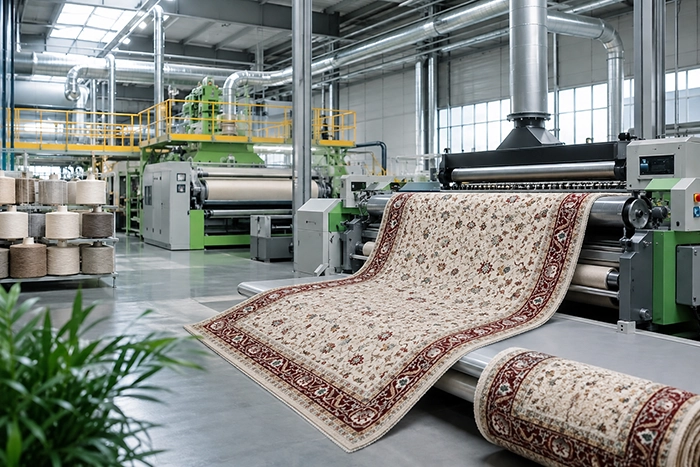
Industrial manufacturers today are under growing pressure to reduce costs, improve environmental performance, and meet the expectations of international buyers. In the flooring sector, this is especially important because carpet production involves multiple energy-intensive stages, including yarn preparation, dyeing, weaving, finishing, backing, and drying. As a result, energy efficiency in carpet manufacturing has become a major priority for companies that want to stay competitive in both domestic and export markets.
Energy is one of the most important cost factors in carpet production. Electricity powers looms, pumps, motors, compressors, and control systems, while thermal energy is used heavily in dyeing, washing, drying, and finishing. If these systems are outdated or poorly managed, factories end up spending more money to produce the same amount of carpet. This not only increases operating costs, but also reduces flexibility in pricing and weakens competitiveness in markets where buyers compare suppliers very carefully.
Beyond cost, sustainability has become a serious commercial issue. Buyers in Europe, the GCC, and other international markets increasingly prefer manufacturers that can show responsible production practices. They want to know that the products they source are made with better resource management, lower emissions, and modern industrial standards. This is why energy efficiency in carpet manufacturing is no longer just a technical improvement; it is also a business and branding advantage.
Why Energy Efficiency Matters in Carpet Manufacturing
Carpet manufacturing is a continuous process where many departments depend on each other. If one stage uses excessive energy, it can affect the cost and efficiency of the entire production line. For example, if dyeing systems consume too much heat or drying lines lose thermal energy, the total production cost rises quickly. In large factories, even small inefficiencies become significant over time because machines run for long hours and output volumes are high.
Another reason this topic matters is energy price instability. Manufacturers that depend on old machines or inefficient systems are more vulnerable to rising electricity and fuel costs. On the other hand, factories that invest in energy efficiency in carpet manufacturing are in a better position to manage their budgets, protect margins, and offer more stable pricing to customers. That stability is especially valuable for exporters working with long-term commercial partners.
1. Upgrading to Energy-Efficient Machinery
One of the most effective ways to reduce consumption is to replace older production equipment with modern, energy-saving machinery. In many traditional factories, old looms, motors, dyeing systems, and compressors consume more electricity than necessary because they were not designed with efficiency in mind. Even if they still operate, they often create hidden waste through excessive power use, poor speed control, and frequent downtime.
Modern machines are built to deliver more output with less energy. Servo-motor powered looms, variable speed drives, and intelligent control systems help regulate movement more precisely and reduce unnecessary power loss. In dyeing and finishing units, advanced machines can maintain temperature more accurately, improve process consistency, and reduce overheating. This makes energy efficiency in carpet manufacturing a practical operational improvement rather than just a theoretical goal.
For a company like Pamchal Carpet, equipment modernization can also support brand credibility. When a manufacturer invests in more efficient production lines, it shows buyers that quality and responsibility are being improved together. This kind of progress is meaningful for international customers who care about both product performance and production standards.
2. Heat Recovery in Dyeing and Drying Processes
Dyeing and drying are among the most energy-demanding stages of carpet production. These processes require large amounts of heated water and thermal energy, and in many factories, a considerable share of that heat is lost through exhaust air or hot wastewater. Without a recovery system, the factory pays for energy that is used only once and then wasted.
Heat recovery systems help solve this problem by capturing unused thermal energy and returning it to the production cycle. For example, waste heat from dryers can be used to preheat incoming air or water, reducing the load on boilers and burners. This lowers fuel consumption and improves overall process efficiency. In practical terms, this is one of the smartest ways to improve energy efficiency in carpet manufacturing because it reduces waste without lowering output.
The benefit is not only financial. Better heat management can also improve process stability, which is important in maintaining consistent dyeing and finishing quality. For manufacturers serving demanding export markets, this combination of lower energy use and better production control creates a strong competitive advantage.
3. Better Lighting, Insulation, and Facility Design
Energy waste does not come only from machines. In large carpet factories, buildings themselves can be a major source of unnecessary consumption. Lighting, ventilation, heating, and cooling all affect the energy profile of the facility. If a factory has weak insulation, poor airflow, or outdated lighting systems, it may waste energy continuously throughout the year.
Replacing conventional lighting with industrial LED systems is one of the easiest improvements. LEDs use less electricity, last longer, and reduce maintenance costs. When combined with daylight sensors or smart controls, they can significantly reduce unnecessary power use during working hours. This is especially useful in large production halls where lighting demand is high.
Insulation also plays a major role. Proper roof and wall insulation helps maintain internal temperatures and reduces pressure on heating or cooling systems. Natural ventilation and better building design can further support energy efficiency in carpet manufacturing by lowering dependence on mechanical systems. Pamchal Carpet can mention such improvements selectively as part of a broader commitment to smarter and more efficient production.
4. Smarter Scheduling and Production Planning
Reducing energy use is not only about upgrading hardware. The way production is planned also has a direct effect on efficiency. Poor scheduling can lead to unnecessary machine restarts, repeated heating cycles, long idle periods, and inefficient short runs. All of these issues increase energy use without adding real production value.
Smarter planning helps factories group similar production batches together, especially in dyeing and finishing. For example, producing similar colors or product types in sequence can reduce cleaning time, setup changes, and energy loss between cycles. Grouping drying operations more efficiently can also reduce heat waste and improve machine utilization.
Digital production planning tools, ERP systems, and monitoring software make this process much easier. They help managers identify waste patterns, smooth out energy demand, and improve daily decision-making. In many cases, better planning can improve energy efficiency in carpet manufacturing even before major equipment investments are made.
5. Maintenance and Energy Monitoring
Even efficient machines can waste energy if they are not properly maintained. Air leaks, clogged filters, worn bearings, poor burner calibration, and damaged insulation can all increase energy consumption. These problems are often small individually, but over time they create serious losses.
Preventive maintenance helps keep machinery running at optimal performance. Regular inspection of motors, compressors, heat exchangers, piping, and insulation can prevent unnecessary waste and extend equipment life. This is one of the most practical and cost-effective ways to support long-term energy efficiency in carpet manufacturing.
Energy monitoring is equally important. When factories track consumption by department or process line, they can identify where energy is being overused and where improvements are needed. Measured performance gives management a clearer basis for decision-making and helps turn energy saving into a structured strategy rather than a general intention.
Conclusion
Energy efficiency in carpet manufacturing is more than a way to lower utility bills. It is a strategic tool for improving cost control, production quality, environmental performance, and export competitiveness. Factories that invest in efficient machinery, heat recovery, better building systems, smart scheduling, and regular maintenance are better prepared for the future of global manufacturing.
For manufacturers that want to grow in international markets, efficient production sends a strong message of reliability and responsibility. Pamchal Carpet can benefit from this approach by showing that modern manufacturing is not only about producing beautiful carpets, but also about producing them in a smarter and more sustainable way.