
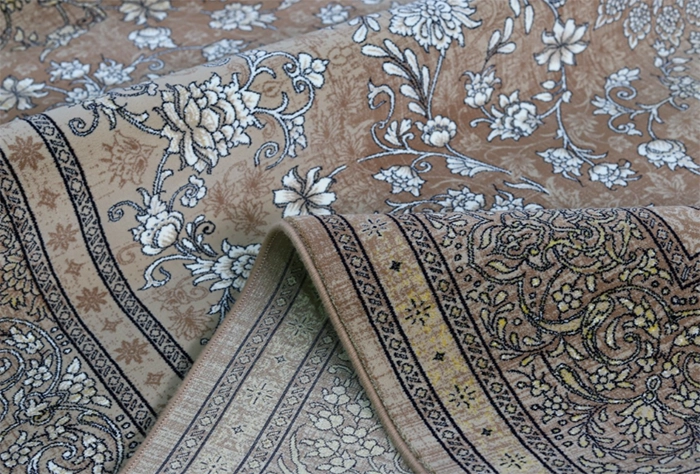
Understanding the Concept of Carpet “Density” in Machine-Made Carpets
In the world of machine-made carpets, quality is not defined by appearance alone. Behind every visually refined carpet lies a set of precise technical specifications that determine its performance, durability, and long-term value. Among these specifications, reed count and density are the two most critical parameters.
A 1200-reed carpet means that 1200 warp knots are woven across each linear meter of width. This directly affects how fine and detailed the design can be. Density, on the other hand, refers to the number of weft knots along the length of the carpet. A 3600 density carpet contains 3600 knots per meter lengthwise. When combined, these two figures define the total knot count per square meter—one of the strongest indicators of overall carpet quality.
As emphasized by the Iranian National Carpet Center,
“1200-reed carpets with 3600 density offer an optimal balance between aesthetic fineness and mechanical strength.”
This balance is precisely why the 1200×3600 configuration has become a benchmark in premium machine-made carpets.
How 1200 Reed and 3600 Density Work Together
Reed count alone does not guarantee quality. A carpet may have a high reed count but low density, resulting in fragile construction and short lifespan. Similarly, high density without sufficient reed count limits design precision.
In a 1200-reed, 3600-density carpet, width-wise and length-wise knot distribution are perfectly synchronized. This creates a tightly interlocked structure where each knot supports the next, producing a fabric that is not only visually refined but also mechanically resilient.
This synergy is what distinguishes export-grade carpets from ordinary commercial products. It ensures that the carpet maintains its shape, surface integrity, and design clarity even under continuous use.
1. Superior Design Sharpness and Visual Precision
One of the most immediate advantages of 3600 density is the ability to reproduce complex and delicate designs with exceptional clarity. High density allows for smaller, more frequent knots, which translates into smoother curves, sharper angles, and greater control over pattern transitions.
Impact on Design Quality
With 3600 density:
- Curved motifs appear fluid rather than pixelated
- Floral and Islamic patterns retain fine outlines
- Medallions and borders show precise symmetry
This level of visual refinement makes 1200×3600 carpets closely resemble high-knot-count handwoven rugs—a key selling point in premium export markets such as Saudi Arabia, UAE, Turkey, and Europe.
2. Structural Strength and Long-Term Durability
Beyond aesthetics, density plays a fundamental role in structural integrity. A higher number of knots per meter creates a tighter weave, which distributes pressure more evenly across the surface.
In practical terms, a 1200-reed carpet with 3600 density:
- Resists pile crushing in high-traffic areas
- Maintains surface uniformity under repeated footfall
- Reduces fiber breakage and deformation
This makes such carpets particularly suitable for mosques, reception halls, conference centers, and luxury residential spaces where longevity is non-negotiable.
3. Improved Texture and Tactile Experience
Despite the tight construction, high-density carpets do not sacrifice comfort—when manufactured correctly. In fact, the opposite is true. The uniform knot tension and fine yarn placement result in a smooth, velvety surface.
This tactile quality is enhanced when combined with:
- Heat-set acrylic yarns
- Controlled pile height (typically 7–8 mm)
- Precise loom calibration
The result is a carpet that feels soft underfoot while remaining firm enough to support posture—an especially important feature for prayer halls and seating areas.
4. Weight, Stability, and Lay-Flat Performance
Carpet weight is often overlooked, yet it has significant functional implications. A denser carpet naturally weighs more, which helps it stay firmly in place after installation.
In large spaces, heavier carpets:
- Resist wrinkling and curling at edges
- Maintain alignment of prayer rows or patterns
- Reduce movement during installation and daily use
For export shipments, added weight also contributes to dimensional stability during transportation, minimizing deformation caused by rolling, stacking, or container loading. Pamchal carpet company carefully calibrates weight-to-density ratios to ensure optimal lay-flat performance without excessive bulk.
5. Enhanced Resistance to Cleaning and Maintenance Stress
High-density carpets perform better under repeated cleaning cycles. Because knots are tightly packed, moisture penetration is reduced and fibers are less likely to loosen or shift during washing or vacuuming.
This is particularly important in environments such as mosques and public halls where:
- Regular cleaning is mandatory
- Steam or low-moisture cleaning methods are used
- Visual consistency must be maintained over time
A 3600-density structure helps the carpet retain its original texture and appearance even after years of maintenance.
6. Premium Market Perception and Commercial Value
In international B2B carpet trade, technical specifications are more than numbers—they are trust signals. Buyers, distributors, and project consultants recognize terms like “1200 reeds” and “3600 density” as indicators of high-end manufacturing.
These specifications:
- Justify premium pricing
- Facilitate comparison in tenders and contracts
- Reduce buyer hesitation in large-volume orders
In Gulf markets especially, clients actively request 1200×3600 carpets as a minimum standard for mosques and luxury projects.
7. Ideal for Export-Grade and Institutional Use
Export markets demand consistency, reliability, and predictable performance. A 1200-reed, 3600-density carpet meets these expectations by delivering:
- Uniform production quality
- Long service life
- Minimal post-installation issues
For institutional buyers—such as religious authorities, hotels, or government facilities—this configuration offers peace of mind and lower lifecycle costs.
Conclusion – Why 3600 Density Defines True Carpet Value
While reed count determines design fineness across the width, density defines the core strength and longevity of a carpet. A 1200-reed carpet with 3600 density represents a carefully engineered balance between beauty and performance.
It delivers superior design clarity, structural durability, tactile comfort, and commercial credibility—qualities essential for premium applications and international trade. At Pamchal carpet company, the 1200×3600 configuration is regarded not merely as a specification, but as a standard of excellence for mosque carpets and export-grade machine-made rugs.