
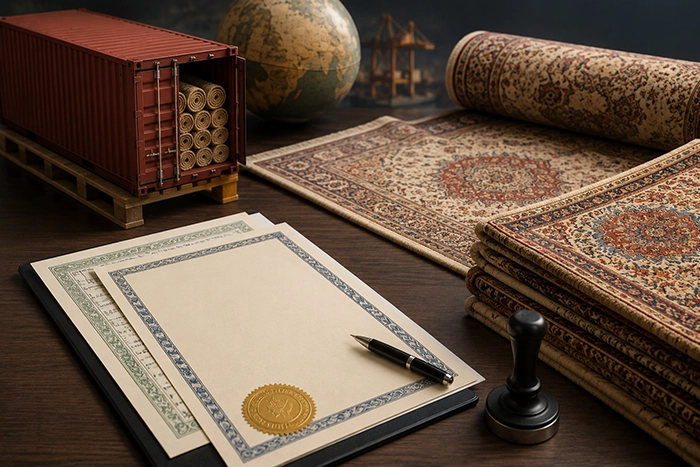
Why Export Certifications Matter in the Carpet Industry
Exporting carpets—especially to regulated markets like the EU, GCC, and CIS countries—requires compliance with a set of technical, environmental, and commercial standards. Without proper documentation, even high-quality products can be rejected at customs or fail to meet buyer expectations. Export certifications act as proof of product quality, safety, and origin.
According to the WTO:
“Standardization and certification are key components of international trade in textiles and floor coverings.”
1. Certificate of Origin (CO)
Issued by the Chamber of Commerce, the Certificate of Origin verifies that the carpet is produced in a specific country, such as Iran.
Why it matters:
- Required by most import authorities
- Supports tariff reductions under trade agreements
- Builds trust with international buyers
Pamchal carpet company includes this certificate with all B2B shipments.
2. Export License from the Ministry of Industry, Mine and Trade (Iran)
All machine-made carpets leaving Iran must have a valid export permit from the Ministry. This document:
- Confirms legal manufacturing and clearance
- Tracks export volume and destination
- Ensures compliance with trade policies
3. Quality Certification (Optional but Preferred)
Buyers, especially in Europe and the UAE, often require third-party testing to confirm that carpets meet specific standards such as:
- Color fastness
- Durability under heavy traffic
- Fiber content accuracy
- Resistance to moisture and mold
Certifications can be issued by labs like SGS, TÜV, or Iranian National Standards Organization (ISIRI).
4. ISO Certifications (Preferred by Corporates)
Carpet exporters who supply to government or commercial projects benefit from holding:
- ISO 9001 – Quality Management
- ISO 14001 – Environmental Management
- ISO 45001 – Occupational Health & Safety
Pamchal carpet company holds ISO 9001 and is in the process of acquiring ISO 14001 for its green production practices.
5. Special Certificates for Target Markets
Different countries may ask for specific certifications:
- GCC countries may request G-Mark or SASO compliance
- European Union may require REACH & CE declaration for chemical safety
- Russia and CIS may ask for EAC mark
Each importer should clarify the required documents before finalizing the order.
Conclusion – Certification Builds Trust and Access
Export certifications are more than paperwork—they’re your brand’s entry ticket into regulated, profitable markets. Manufacturers like Pamchal carpet company ensure full documentation for every export, making transactions smoother and more professional for buyers around the world.